Notes on doing most good, doing some good, and living good

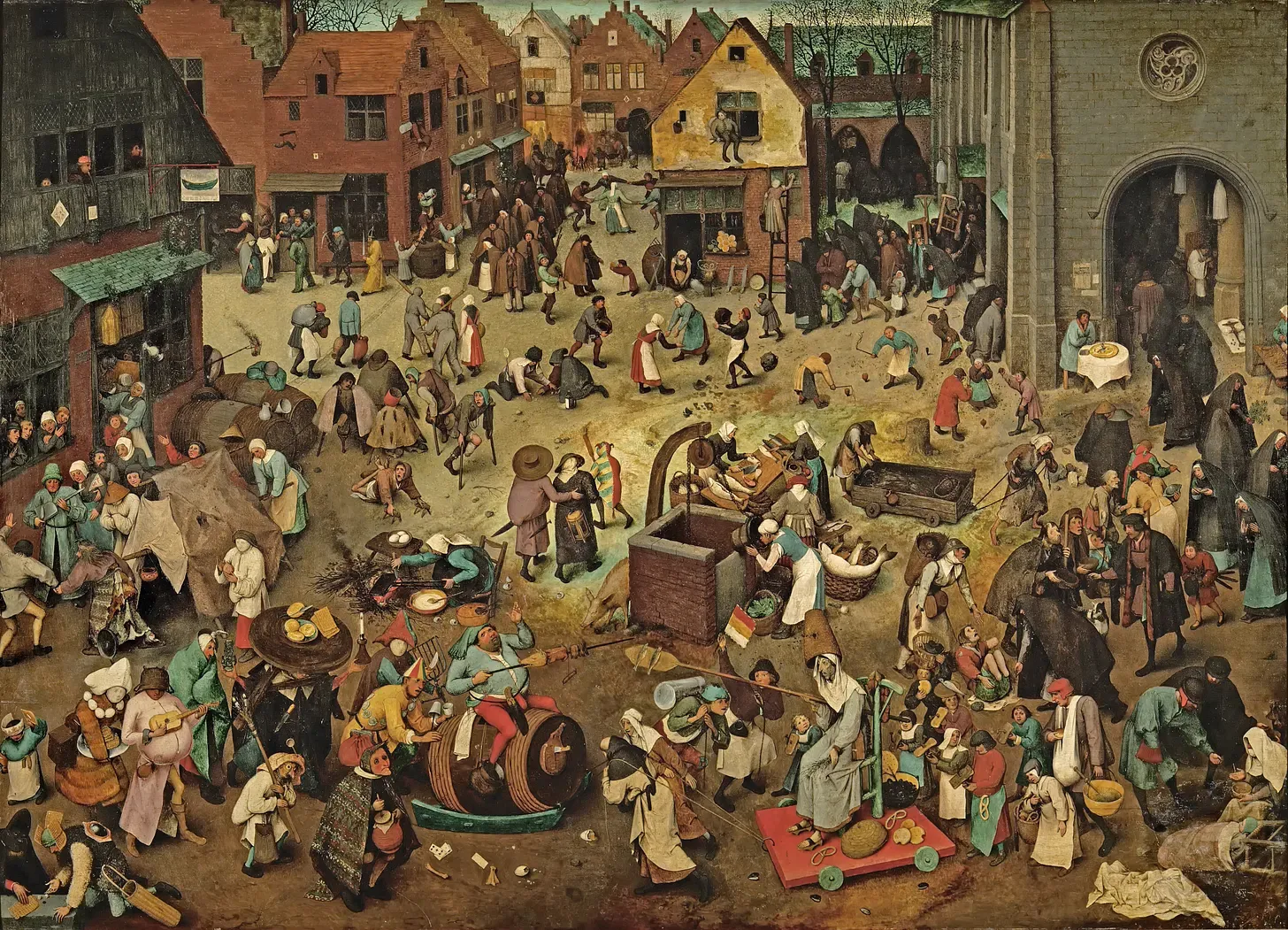
The Fight between Carnival and Lent, Pieter Brugel (a metaphor for the complex ecology of altruism)
I was intending the earlier draft to be a long-winded diatribe against EA (in short, for Effective Altruism), and half-way through writing this draft had realised how I was right, and wrong in some places. I softened my stance afterwards, after this chat I had with an hardcore effective altruist, who has been donating 10% of his salary every month for 10 years. I changed my viewpoint, and realised that no ideology is perfect, and SOME altruism, is better than no altruism at all. After all, who was I to judge them in my high-horses to tell that they are wrong? But I also came to a conclusion that SOME altruism is better than MOST altruism, which is not a popular perspective people have. And I am going to use this essay as a vehicle to propogate this meme.
And to articulate this opinion, I’ve ended up with pure, raw notes around fundamentally three variants within altruism: effective altruism, obligatory altruism, and excited altruism. These bulleted notes would be in a similar fashion of Wittgenstein’s Philosophical Investigations, I will be meandering around the topic of altruism, forming a haunting constellation, if at all anything. I will criss-cross the terrain, rather than take a singular express highway. This, I felt was the best way to describe my complicated opinion on altruism: on what it means to live good, do good, do some good, or do most good1
-
EA at best is a flawed philosophy with GOOD intentions. Now that this has been converted into a form of pseudo-religion in the Bay area of SF, points to the fact that it’s working at scale, and helping convert the masses to practise altruism. I appreciate this in the same way I appreciate charitable education conducted by the Catholic churches — flawed philosophy with good intentions, and occasionally conducting benevolent practises. Religions, whatever else they do, are behavioural technologies, they make people actually do things. If a pseudo-religion convinces a software engineer earning $250k to donate 10% of their salary every year to malaria prevention, this is already considerably more altruism than a philosophy which produces excellent dinner-table conversations and zero mosquito nets (we will come back to mosquito nets in some time)
-
Say if you had $5000 as cash at hand, EA would tell you that the best use of that money for altruistic purposes would be then distribute roughly 900 nets at around $6 each, so that you could effectively prevent ~1 expected death. The actual GiveWell model is much more detailed than that, but you get the point. Saving a malaria-related death might be the best use of that $5000 to save a person’s life. To me, this does sit strangely in my mind, it’s rational, but counter-intuitive? So, I just stop giving tips to the homeless person on the street close by?
-
And if I do give that homeless person £10, why would I do that? That £10 could have gone somewhere else. The £5 coffee, or the €20 donation to the local friends charity, could have gone somewhere else. Once morality is phrased as an optimisation problem, everything acquires an opportunity cost. In this framing, genuine generosity starts producing guilt.
-
I did mention earlier that EA is a flawed philosophy, but one thing which it does well is to make altruism “legible” by being measurable. Putting mathematical effectiveness into altruism itself is a different mode of thinking. And it gives legibility on various levels. First, it has a crystal clear vision to “do good as much as possible”, without much ifs and buts. Clear success metrics, clear everything. Illegibility for EA folks, is viewed rather as something to be conquered and minimized. The bureaucrat’s war cry becomes: okay, this thing is difficult to measure? let’s figure out how to measure it! Whereas, most organisations are very “fuzzy” in terms of legibility, think of Amazon and think of Google, how coherent are they with their marketese, and what they do internally? But not with EA..
-
The fact that EA is not “illegible” also brings forth a lot more side effects. Just like how agrarian societies had foundational inventions in the storage of grains through agriculture etc making it “easy to store”, it also became easy to tax as a side effect. These were all side effects despite the larger benefit of being able to “feed as much grains to as much people as possible”, sounds pretty EA-esque doesn’t it? Morality becoming legible leads it to be: countable, comparable, fundable, rankable. These are all good things, but certainly there are side effects?
-
James C. Scott (famous for his central idea around legibility) has this recurring suspicion towards systems that improve legibility. Making something legible is not itself bad, governments and organisations need legibility to function. The problem comes when the map slowly starts replacing the territory. If a forest is measured only in terms of timber yield, then bushes, mushrooms, insects, decomposing wood, villagers gathering firewood, children playing, all start looking like irrelevant noise. Morality can undergo the same flattening. The person who spots something nobody else spotted, the friendship which keeps somebody going, or the art which changes somebody’s life without producing a measurable DALY are all examples of things whose value becomes easy to ignore merely because they remain illegible.
-
To illustrate the “harmful” side effects of legibility: let’s say, you’re reading your favourite book because you love reading it, versus reading the exact same book because there is an exam tomorrow and you need an A+. Externally, the activity might look identical. Internally, these are completely different experiences. In one case the book is an end, in the other it is purely a means. I have a suspicion that a lot of maximised altruism turns life into the second kind of reading.
-
By trying to argue against EA with reason and scientific temper, is in a way endorsing the view which EA poses. To use critique and reason to do “most good”. Disagreement over which activity does the most good, does nothing to touch EA. This is something like EA-judo. You say “maybe AI safety isn’t the most important cause”, they say great, let’s investigate which cause actually is. You say “maybe animal suffering is undervalued”, they say great, let’s update the model. You say “your measurements are bad”, they say great, let’s improve the measurements. EA happily eats most criticisms for breakfast. And I’m not telling you to NOT cultivate reason or critique, but…
-
What might probably put an inkling of doubt on the premise of EA is the question on whether doing “most good” is indeed the right way to do things. My spicy take here is that this doesn’t make sense at all. To me, “some good” is better than “most good”, as the moment you tend to look at maximising the “most good”, you tend to look less at doing less of the “living good”. You could be this evil power hungry boss, who is making your employees work like slaves, but still donate 90% of your income to the most noble causes that do the “most good”. There is something deeply strange about a philosophy under which this “evil boss” could theoretically become a moral superstar without becoming a nicer person. He could shout at everyone in the office, destroy people’s self esteem, never call his mother, exploit the cleaner, and then calculate that his £2 million annual donation to malaria prevention outweighs every other shit-show he is culpable of. Under the calculator, maybe he comes out net-positive.
-
“Living good” does seem to be more important than “most good”, as your life is synchronous. If your inner life, and your outer life is not synchronous to the altruistic values you stand for, you feel like shit (which also explains why many hardcore EAs have a crash after practising for 7-10 years and become epistemically lonely). By delegating your morality to an external organisation, you’re also getting dictated by an external compass. When this happens, your internal moral compass gets weakened, diluted, and watered down.
-
EA is rightly suspicious of altruism which exists purely because it makes the donor feel warm inside. Fair enough. Donating £100 to something useless because the website has a cute puppy photograph is not necessarily better than donating £100 to something boring but useful. But does feeling become morally irrelevant? Especially when the head usually rationalises what the heart had already pointed towards? Reason often comes as a retrospective justification for what emotion has already selected, so there IS a difference here when it comes to “feeling good” and “doing good”. And you cannot just completely dismiss this stance.
-
The utilitarian calculus sitting behind the EA worldview also starts generating increasingly strange outputs the more seriously you take it. Why give 5 could contribute towards saving a child in Bengal? Okay. Why give money to museums? Why spend government money restoring old buildings? Why maintain a library? Why spend money on flowers in public parks? Why spend £200 on your own wedding?
-
I know the standard response here: no serious EA actually behaves like this, there are weak-EAs, strong-EAs, hardcore-EAs, integrated-EAs etc etc. Strong-EA treats “do the most good you can do” extremely seriously. Weak-EA says maybe donate 1%, or 10%, think carefully about where the money goes, don’t ruin your life. All excellent advice!
-
Say you had to choose between preventing one person from being slowly eaten by sharks, or preventing a googolplex number of people from experiencing a hiccup. If a hiccup has any negative utility whatsoever, there must theoretically be some sufficiently enormous number of hiccups whose summed disutility becomes greater than the shark attack. Another case of repugnance. So many of these edge cases when we apply EA ideology, that I don’t think they’re edge cases anymore..
-
But perhaps good and evil do not form a single well-ordered set in the first place. Some goods are comparable, while others are not, and can’t be put under the same set. £10 versus £100 given to the same intervention, fine. Saving ten lives versus saving twelve comparable lives, perhaps fine. But warm socks, beautiful music, friendship, hiccups? If somebody stood above a shark tank holding both the cure for all future hiccups in one hand and a little girl in the other, and shouted to the planet “I can only save one”, I suspect the planetary vote would be close to 100% for the girl. The utilitarian might complain that our intuitions are biased. Maybe. But when a moral philosophy repeatedly concludes that ordinary moral intuition is malfunctioning, at some point I begin wondering whether the philosophy is the thing malfunctioning.
-
Consider also the decision to have a child. You can make a spreadsheet. Less disposable income, less sleep, less free time, more stress, nappies, school fees, childcare, climate impact, one more human consuming resources. Why would you then even go for a child? Before becoming a parent, the costs placed on this spreadsheet are absurdly legible. But the actual stuff for which you become a parent is bizarrely illegible. “Meaning”, “love”, “becoming a different person”, “having this particular human being exist”, all these are not legible, and cannot be placed even, on Excel columns..
-
This is what the book by Russ Roberts titled Wild Problems gets at. Some decisions cannot be evaluated merely by asking whether they are “worth it”, because choosing them changes the person doing the choosing. Before becoming a parent, you cannot fully know what it is like to be the future version of yourself who is a parent. Marriage, friendship, art, migration, religion, vocation, parenthood, perhaps altruism itself, all contain this property.
-
Which brings another axis missing from the utilitarian ruler: meaning. Meaning lets us voluntarily absorb enormous amounts of short-term suffering. Someone trains for a marathon and willingly suffers. Someone spends five years doing a PhD on an obscure fungus. If pleasure minus pain was the operating system of human life, half of civilisation shouldn’t exist.
-
There could be meaning even in cleaning and washing dishes. If washing dishes is purely instrumental — dirty dishes → clean dishes — it is annoying. If you somehow start enjoying the warm water, the small act of restoring order, noticing stains others would have missed, suddenly some part of the activity becomes an end in itself. What I’m trying to get at is that if you take enormous care of a single specific person and do that for the rest of your life, you would still “feel” good about it, and also make this conclusion that what you’ve done is right..
-
The head can’t even do head stuff without the heart. We’re narrative creatures, and it doesn’t feel right when we try outsourcing judgement to a game of numbers (eg. the EA leaderboard). Narratives go a long way. In Charles Stross’ Singularity Sky, you have civilisations so technologically advanced that once space, matter and energy are solved, narrative becomes one of the remaining games worth playing. Even the Hindu God, Krishna, depicted as omnipotent and omniscient, is weirdly left with leela (narrative play), relationships, and rasa as there is nothing else to do (apart from spinning stories) once you’ve conquered everything. So is the answer then that we should strive not for “most good for most people”, instead strive for “most effective story of good” ?
-
Take Rachel Carson’s Silent Spring. The raw scientific evidence around DDT mattered enormously, of course, but the thing which escaped the laboratory and entered public consciousness was a story about a spring without birdsong. Nobody remembers a pesticide-effectiveness leaderboard. They remember the framing, the image. This is an example of “most effective story of good” in this marketplace of ideas, which worked.
-
This is another reason why the “altruism leaderboard” feels morally repugnant to me. Not because ranking interventions is always useless, ranking is obviously useful when allocating constrained resources, but because the ranking starts pretending to have fundamental moral status. Who knows what could topple this board? Is it AI-safety related p-doom risk? Should we all just put more money into AI safety to save more people’s lives?
-
Imagine if the universal gravitational constant kept changing depending on whether you were in Manchester, Bangalore or Alpha Centauri. You wouldn’t preserve the theory by adding increasingly elaborate footnotes: “gravity is universal except Tuesdays in Manchester, where use equation B”. At some point, you probably need a different theory. So if effective altruism is dicey philosophy which still works mostly, we need to replace the philosophy with a better one. Ideology should also be subjected to falsification, like science.
-
I think the maximalism in EA — the phrase “as much as possible” — is where much of the trouble originates. I’m much more interested in two other questions: what ought I do, irrespective of whether I am excited by it? And what altruistic things am I unusually excited to do, such that I might happily carry them for 10 years?
-
Obligatory altruism is the boring one, and therefore perhaps deserves more respect. You do something because you ought to do it. You take care of your parents because they are your parents. You show up for a friend because they are your friend. You help the person who collapsed beside you because they collapsed beside you.
-
There is something like an essence to friendship. There is something like an essence to art, to paintings, museums, music, taking care of children, keeping promises, feeding guests. I know “essence” is a dangerous word and philosophers will arrive at my doorstep with pitchforks, but I do believe that there is this Aristotelian essence in the good things we see in this world. You do not read Dostoevsky because RCTs demonstrate that Russian novels produce 0.03 additional units of moral enlightenment per hour. Beyond a certain point, you don’t give two shits about whether there is any peer-reviewed published science that corroborates your actions..
-
Excited altruism is the other direction. Perhaps the most personal is also the most altruistic, precisely because you carry it with your heart. Someone obsessed with blindness might spend their life designing tactile maps. Someone who cannot stop thinking about abandoned dogs might build the world’s best shelter software etc, where the excitement itself becomes the fuel for your engine.
-
This is obviously dangerous if taken alone. “I am excited about helping rich people buy nicer yachts” is not redeemed merely because I’m excited. Personal preference itself can be morally stupid. Which is why I’m not proposing we replace one universal theory with another universal theory called Excited Altruism™, create an EA Forum competitor and start ranking excitement-adjusted charitable interventions.
-
Maybe the correct architecture looks more like a barbell. Keep one part deliberately boring, legible and effective. Donate 1%, 5%, 10%, whatever amount you can sustain, to highly effective organisations. Let GiveWell do spreadsheet things. Let somebody calculate mosquito-net coverage, vaccination effectiveness, cash-transfer multipliers etc. This is useful machinery and we should probably use it. And then keep another part deliberately illegible. Help your neighbour. Teach somebody something. Volunteer locally. Support an artist you love. Spend ridiculous amounts of time on a cause which you have no RCT proving will work, but which you cannot stop thinking about.
-
Nassim Taleb’s barbell strategy was originally about surviving prediction errors: be extremely conservative in one part and extremely aggressive in another rather than mediocre everywhere. Something analogous might work here. Keep a portion of altruism extremely evidence-driven, boring, repeatable and legible. Let another portion remain high-variance, personal, local, experimental, excited and gloriously difficult to quantify.
-
A world in which nobody ever donated to a museum because mosquito nets always rank higher would eventually become a very strange world. A world without useless mathematics, experimental poetry, cathedrals, obscure archives, weird instruments, regional dances, philosophy departments, restoration projects, public gardens, old libraries etc would ALSO be a strange world.
-
There is also something suspicious about EA’s hostility towards proximity. The child in front of you matters more than a statistically identical child 5,000 miles away. We live inside families, streets, neighbourhoods and cities and it’s a struggle NOT to have our morality embodied in it..
-
Perhaps the topic of proximity when it comes to morality is not that it should be a local versus global argument..seems to resemble more of a fractal looping pattern. There is this lovely framing in politics which explains how our ideology shifts with scale: “With my family, I’m a communist. With my close friends, I’m a socialist. At the state level of politics, I’m a Democrat. At higher levels, I’m a Republican, and at the federal levels, I’m a Libertarian.” The exact politics isn’t the point. The point is that different scales may legitimately even require different moral systems. With your child, impartial utilitarianism would be psychopathic. If your daughter needs £20 for school shoes, you don’t open GiveWell to check whether another child somewhere else has a higher marginal utility for the same £20. You buy the shoes. This is your daughter. Nobody would do that..
-
Expand one circle outward. Perhaps moral concern can expand outward without erasing the special significance of what’s near you. Expanding the blast radius of altruism doesn’t require us to flatten the landscape. Some of the more interesting EA off-shoots have independently ended up somewhere near this idea under names like “integral altruism”, where global scope-sensitive impact is deliberately balanced against intrinsically valuable local things such as friendship, love, beauty, family and the sacred. Which is funny, because after travelling through several thousand words of utility calculations, we seem to have rediscovered the original definition of grandmother morality.
-
Which makes me think morality is perhaps less like an optimisation algorithm and more like an ecology. It has multiple species in it. Obligation. Love. Excitement. Effectiveness. Loyalty. Beauty. Justice. Mercy. Meaning. Proximity. Impartiality. Try converting the entire ecology into a 1D-map and you may get phenomenal short-term yields, but you’ve also made the soil extremely fragile. Just like what high-modernism did to German forestry, they turned them into a monoculture.
-
This is probably where I have moved the most while writing this. My initial instinct was: EA is wrong, therefore reject EA. My current instinct is almost the opposite: EA contains a tool which is so useful that it becomes dangerous when promoted into a complete philosophy of life. Cost-effectiveness analysis is excellent. Evidence is excellent. Reason is excellent. Mosquito nets are excellent. But “most good” is perhaps better treated as one instrument inside morality rather than morality itself.
-
So perhaps some good > most good, but only in the strange sense that some good sustainably woven into your life may be better than permanently trying and failing to optimise every moral decision. A person donating 10% for forty years, helping neighbours, caring for family, making art and being a decent colleague might do considerably more good than someone who spends three years trying to become morally optimal, burns out, becomes a husk, and never wants to hear the word altruism again.
-
Obligatory altruism gives us the things we must do even when we are not excited. Effective altruism gives us tools for asking whether our actions actually work. Excited altruism gives us the energy to attempt things which no spreadsheet could have instructed us to care about in the first place. If we go with our earlier direction that morality is an ecology, this line of thinking makes sense. These are not competing religions. The trouble begins when one organ decides it is the entire organism.
Read more
- Home is where the feeling of home residesreflections
- Notes on Londontravel
- 18 key ideas from reading Henrik Karlsson this monthwriting
- Venn-diagram based decision makingmathematics
- Co-creative loops are everywheremental-models
- Life lessons and hot takes from my 30slifestyle
- Building a skill for coherent science illustrationsscience
- My agentic engineering workflow (step by step)agentic-coding
- Hammock driven developmentagentic-coding
- Peculiar ways number three fits into our funny little brainsmental-models
- AI sandwich as a defacto principle for anything agentic engineering relatedagentic-coding
- Authority in the guise of evidencecritical-rationalism
- Map is not the territoryphilosophy
- Self hypnosis as a manifestation ritualmeditation
- Hegelian dialectic for structured reasoning with AI agentsphilosophy
- How I prepare for tough negotiations nowadaysnegotiation
- When should we steelthread somethingproduct-development
- Breadboarding, shaping, slicing, and steelthreading solutions with AI agentsproduct
- Healthy conflict in teams have a tipping pointteam-building
- How I deslopify AI writingwriting
- How I started building softwares with AI agents being non technicalagentic-coding
- Read raw transcriptswriting
- Legible and illegible tasks in organisationsproduct
- L2 Fat marker sketchesdesign
- Writing as moats for humanswriting
- Beauty of second degree probesdecision-making
- Boundary objects as the new prototypesprototyping
- One way door decisionsproduct
- Finished softwares should existproduct
- How I periodically rank my rough draftsobsidian
- Flipping questions on its headinterviewing
- Vibe writing maximswriting
- How I blog with Obsidian, Cloudflare, AstroJS, Githubwriting
- How I build greenfield apps with AI-assisted codingagentic-coding
- We have been scammed by the Gaussian distribution clubmathematics
- Classify incentive problems into stag hunts, and prisoners dilemmasgame-theory
- I was wrong about optimal stoppingmathematics
- Thinking like a shipmental-models
- Hyperpersonalised N=1 learningeducation
- New mediums for humans to complement superintelligenceagentic-coding
- Maxims for AI assisted codingagentic-coding
- Virtual bookshelvesaesthetics
- It's computational everythingtrends
- Public gardens, secret routesdigital-garden
- Git way of learning to codeagentic-coding
- Style Transfer in AI writingagentic-coding
- Understanding codebases without using codeagentic-coding
- Vibe coding with Cursoragentic-coding
- Virtuoso Guide for Personal Memory Systemsmemory
- Writing in Future Pastwriting
- Publish Originally, Syndicate Elsewhereblogging
- Poetic License of Designdesign
- Idea in the shower, testing before breakfastsoftware
- Technology and regulation have a dance of ice and firetechnology
- How I ship "stuff"software
- Writing is thinkingwriting
- Song of Shapes, Words and Pathscreativity
- How do we absorb ideas better?knowledge
- Read writers who operatewriting
- Brew your ideas lazilyideas
- Trees, Branches, Twigs and Leaves — Mental Models for Writingwriting
- Compound Interest of Private Noteswriting
- Conceptual Compression for LLMsagentic-coding
- Meta-analysis for contradictory research findingsdigital-health
- Proof of workproduct
- Gauging previous work of new joinees to the teamleadership
- Task management for product managersproduct
- Beauty of Zettelswriting
- Stitching React and Rails togetheragentic-coding
- Exploring "smart connections" for note takingwriting
- Deploying Home Cooked Apps with Railssoftware
- Repetitive Copypromptingwriting
- Questions to ask every decadejournalling
- Balancing work, time and focusproductivity
- Hyperlinks are like cashew nutswriting
- Brand treatments, Design Systems, Vibesdesign
- How to spot human writing on the internetwriting
- Can a thought be an algorithm?product
- Opportunity Harvestingcareers
- Everything is a prioritisation problemproduct
- Nowlifestyle
- How I do product roastsproduct
- The Modern Startup Stacksoftware
- In-person vision transmissionproduct
- How might we help children invent for social good?social-design
- The meeting before the meetingmeetings
- Design that's so bad it's actually gooddesign
- Lessons learnt interview prepping for product rolesinterviewing
- Obsessing over personal websitessoftware
- English is the hot new programming languagesoftware
- Better way to think about conflictsrisk-management
- The role of taste in building productsdesign
- Dear enterprises, we're tired of your subscriptionssoftware
- Products need not be user centereddesign
- World's most ancient public health problemsoftware
- Pluginisation of Modern Softwaredesign
- Let's make every work 'strategic'consulting
- Making Nielsen's heuristics more digestibledesign
- Startups are a fertile ground for risk takingentrepreneurship
- Insights are not just a salad of factsdesign
- Minimum Lovable Productproduct
- Methods are lifejackets not straight jacketsmethodology
- How to arrive at on-brand colours?design
- Minto principle for writing memoswriting
- Importance of Whytask-management
- Quality Ideas Trump Executionsoftware
- Why I prefer indie softwareslifestyle
- Use code only if no code failscode
- Self Marketing
- Personal Observation Techniquesdesign
- Design is a confusing worddesign
- A Primer to Service Design Blueprintsdesign
- Rapid Journey Prototypingdesign
- Visualise detailed file structures on CLIcli
- Do's and Don'ts of User Researchdesign
- Design Manifestodesign
- Complex project management for productproducts
- How might we enable patients and caregivers to overcome preventable health conditions?digital-health
- Pedagogy of the Uncharted — What for, and Where to?education
- Future of Equity with Ludovick Petersinterviewing
- Future of Ageing with Mehdi Yacoubiinterviewing
- Future of Tacit knowledge with Celeste Volpiinterviewing
- Future of Mental Health with Kavya Raointerviewing
- Future of unschooling with Che Vanniinterviewing
- Future of Rural Innovation with Thabiso Blak Mashabainterviewing
- Future of work with Laetitia Vitaudinterviewing
- How might we prevent acquired infections in hospitals?digital-health
- The why to endure any howentrepreneurship
- Design education amidst social tribulationsdesign
- How might we assist deafblind runners to navigate?social-design