Life lessons and hot takes from my 30s

I recently read Kevin Kelly’s Excellent Life Advice for Living. And immediately after that, on Substack, I also came across Nabeel Qureshi’s Substack post which is in this similar genre of being a listicle. I felt a genuine urge to articulate my own life lessons in this wonderful format and share it across to the world. So here goes:
-
I’m angry not because someone else did something wrong, and I’m venting it out by being angry. That’s not true. I am angry because I’m trying to prove that I’m better than the other person who made that blunder. If someone spilled tea on my shirt, I get angry to show the supremacy of my ego more than anything else. Anger is not serving the function to solve the problem of “tea being spilled on my T-shirt”. As there is no utility of anger, there is no need to get angry (I keep telling this myself every time I get angry that it’s my ego playing supremacy games). If this seems illogical and absurd, read Courage to be Disliked.
-
While handling difficult conversations, bend the voice and modulate it in such a way that there is this parabolic tilt. It’s called the Late night FM DJ voice. Even if you’re dealing with a terrorist kidnapping or a hostage situation, bending your voice like Beckham, making it slope downward, calms and eases up any person who is listening to it. End it in a descendo, and not a crescendo.
-
While taking risks, I ask myself “what’s the worst thing that could happen?”. Nothing is as worse as one imagines.
-
If given a task, I get to the 5% done state as fast as possible. It doesn’t matter if this is accurate. It would be hardly perfect, but I’ve already reached critical velocity to make sure I accomplish the task sooner. It saves a lot of back and forth and contemplation whether it’s a task worth doing or not. Often we spend more time thinking about what to do, rather than doing. This reduces the gap even further. And if something takes less than 2 mins to do, I do it right away, why think? One of my favourite writers of all time, Derek Sivers talks about the same in this essay titled “take the first step immediately”
-
While trying to grasp a complex subject, see if you can find a “philosophy explainer” of the same. For example, for doing software design I chanced upon the book, The Philosophy of Software Design by John Ousterhout which primes the reader with various cognitive pumps and thinking tools to help structure one’s chain-of-thought in a better way while building software. Nowadays as we hardly “write” code but rather instruct the coding agents instead, the grounding with this philosophy primer has stayed with me even more.
-
Best advantage would lie in mastering three-word niches. If you are trying to master “product management”, not much of an advantage. But if you’re doing “Healthcare product management” then there is some benefit, but not truly an undetectable advantage. But if you’re really wanting to double down then probably “Healthcare product management with AI tooling enabled” could be three-word niche which has benefits if one masters. Three word niches are also easier to discover both to search engines, as well as ChatGPT and various other generative tools. It could be anything ranging from medieval-snail-enthusiasts, to espresso-drinking-airport-lounge-nomads
-
Read one chapter at a time for non-fiction, and spend atleast a significant period waltzing around thinking out loud the ideas. The thinking should be more in terms of cultivating intuition and less towards rote comprehension. Only proceed to the next chapter when understanding is satisfactory, and use ChatGPT to steelman and strawman the ideas. Also make sure you’re walking around, so the exploratory mode of thinking is ON.
-
Best way to freshen yourself up is to take a double-espresso shot (or a lungo) and then couple it with a 25-min nap. Works like a charm. I call it the “nappucinno”
-
When you smell BS whataboutery in a conversation, do a “two degree probe”. Probe once, and then probe one level deeper. Those who are good at BS might have subterfuge tactics to circumvent one degree probe, but not for the second degree probes. Three-level probe is dangerous, don’t do that ⚠️. Nobody likes to be asked why, why, why (I suspect this is because of the MBA-ization of english language, especially the “5 Whys” technique, along with the 3Ps of success, and 4Ps of management)
-
Contrary to what people otherwise think, solution can also influence the problem, your practise can also influence more “belief”.. most of these are kekulean co-creative loops that feed into each other. I try not to think in a linear fashion. Once you see it, you start seeing it everywhere: ageing, and disease. Or even: problem, and solution. This is also a classic example of a systems thinking perspective and what’s categorised as a”reinforcing loop”.
-
If non-fiction is for the mind, fiction is for the heart. There should actually be more bibliotherapists out there. In some situations, all you need is a good book to feed your soul. I read Courage to dislike yourself by Ichiro Kishimi, at a cathartic phase in my life, and it helped me recover better.
-
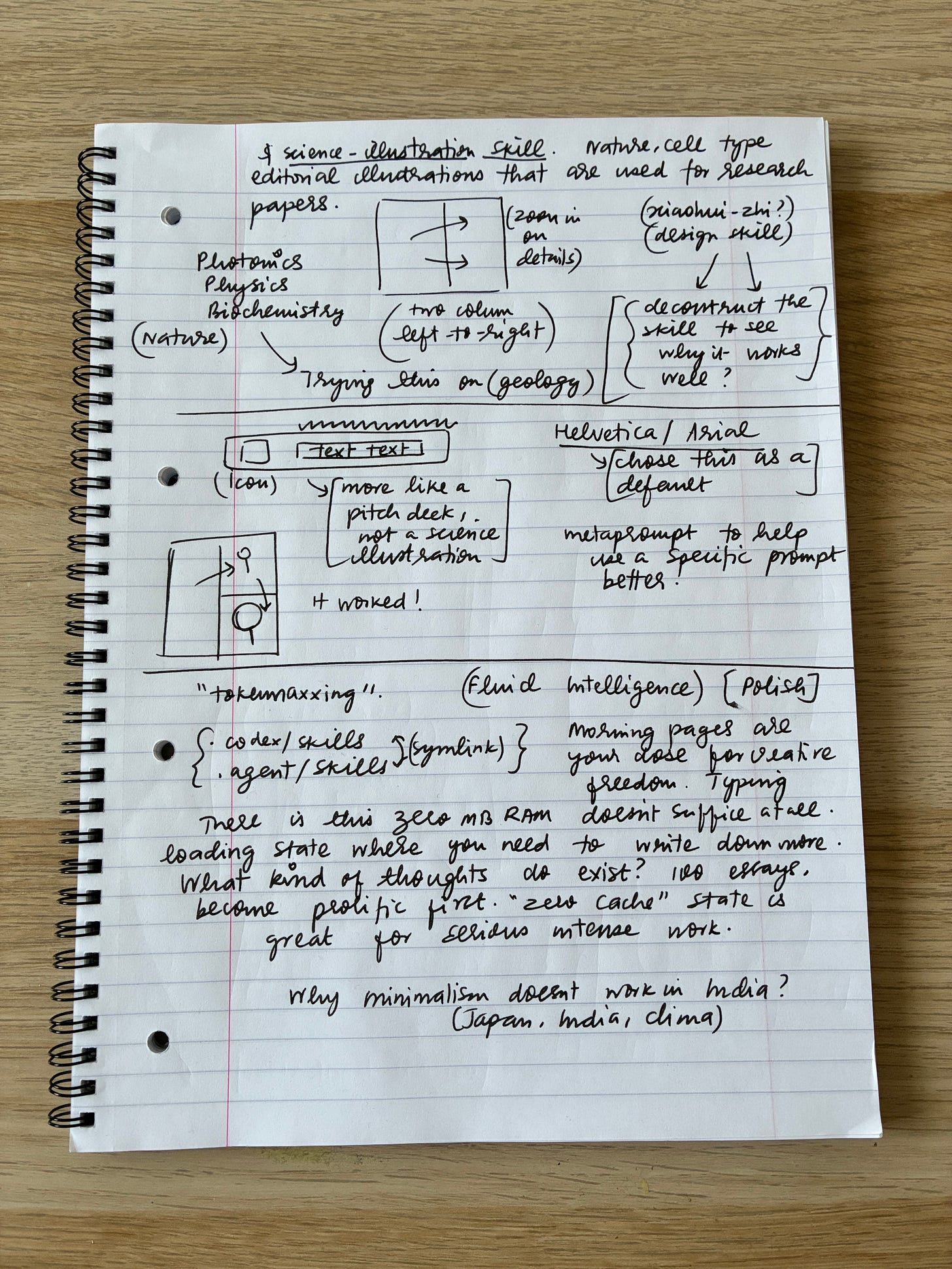
Keep a notebook with a Uniball 0.7 mm always nearby your laptop desk. Typing is faster, more efficient and all that, but writing with hand activates much more parts of our neural circuitry. Whereas typing decomposes into a single act, triggering neurons in only a selective part of the brain. I did remember seeing this research, but now I’m not able to quote/hyperlink it as I’m not able to find it.
-
Listening to bird songs, especially the cackling melodies in the rainy forest types are so great for calming you down. I also listen to the Slack’s elevator music on repeat for these reasons, and more recently I’ve come to a conclusion that the bird songs are more soothing, and there ought to be an evolutionary biology that explains this behind the scenes.
-
When I’m listening to someone on a call, I keep speaking and exhaust all possibilities of unanswered questions they might have. I keep probing, “and then?”.. “and then..” or “Is there anything more?” Etc etc until the tap is dry. Whatever needs to be shared should be shared, and is to be listened in to.
-
Internet is not always noisy, it’s just unevenly distributed. People who use X for politics, might have a different notion of X consumption as compared to those who use it for AI researchers alpha. For X, I block the politics, block the finance bros, block also the crypto bros etc and etc. eventually I only have one specific focussed feed for X that gives me what I want. Also mute words like “politics, crypto, sports” etc forever.
-
Best way now to network with interesting minds is to submit a PR intro. You find a project the creator has published on github and then contribute to that project by pushing a PR. When the PR gets accepted, it becomes a badge of accolade, and could be a precursor to something even bigger (maybe you collaborate with the creator next as you’ve already proved your value through proof of work?)
-
Happiness is a skill. The framing that this is a “skill” and not just a turbulent river which ebbs and flows as happiness/sadness/melancholy etc is important to keep aware.
-
There is an art associated to accepting praise gracefully. And denying a compliment is not the best strategy. As La Rouchefoucauld puts it “the ability to deny praise is a tendency to accept praise twice”. When someone compliments you, just take it. That’s the best way
-
I try my best to write to creators whose creations resonate with me. If I liked a particular thought or an idea from your essay which I read, then I want to write to you to explain why. I DM’d Vishan Veerasamy on his YouTube vlog series, and he replied back with a thumbs up. That’s all I want, folks
-
I think Poker is the best game ever and everyone should learn how to play it (Mafia comes as a close second if there are 12+ players). Poker is crafty in the way it mixes skill and luck, and it’s a simulacra of how it would play out in a real world scenario. You always have an ungodly balance of skill and luck. Chess is interesting but boring because it’s all so heavily deterministic. But not Poker. I didn’t say this BTW, John Neumann described this about Poker. For learning the mathematics of Poker, this is a fascinating lecture series on YouTube.
-
Every city has a vibe. And it’s a gross injustice to the human product (yes, you) if we don’t do enough aura farming to harvest this energy. Paul Graham talks about this in his essay where he says London reeks of “culture appreciation”, New York about money, Boston about being smart etc. I want the city to wear off its aura on me.
-
If you’re tired of social media feeds, use an RSS feed instead. Maintain a list of important writers, and read regular essays from them via RSS (I recommend Netnewswire, as a RSS reader app). This is a list that Karpathy maintains to keep abreast of AI engineering.
-
When I decide to write, often the best ones are when the emotions attached to the storyline are so overwhelming, the pot is brimming with excitement to share it out loud.. it’s as if your thoughts are passing through various stages of matter: from its fuzzy gaseous state, then into a liquidy jelly like state, and then into a highly emotive solid state where your internal molecules are all buzzing and vibrating. That’s when the best drafts are written, I think. For instance, I wrote this after a medical appointment while sitting in the Starbucks cafe and waiting. I wrote this all on my smartphone as I couldn’t wait anymore.
-
Language is a powerful technology. Everyone around you is forging it for their own best interests, like it or not. It took me a long time to realise why “global warming” was more useful to use than “climate change”. Please read more George Lakoff.
-
If you are on a long-winded conversation with your friend filled with a lot of non-sequitors sprawling multiple topics, do your friend a favour and drop links on WhatsApp after the convo has ended. This is the WhatsApp equivalent of the literary “footnote” for books.
-
Write down the goals you want to achieve this year and speak them out loud in your own voice, record and save it on your phone. If you have an iPhone, trigger an Apple shortcut which launches every night at 10:30 PM, forcing you to listen to this message. I’ve been doing this for 2 months and feel pumped up for the days to come..
-
Talking to my wife, I naturally end up in a problem-deconstruction-solving mode, and it took me a long-long-long time to realise that I don’t have to always be in this mood, and the adage “men are from Mars, women from Venus” is a cliche that exists for a reason. So now, I ask beforehand ‘Should I help solve or should I listen’. You might mostly get an answer right away, and for even more difficult situations, you would need a bit more fine tuning your antennas for accentuated sense making of whether it’s a “solve it” mode, or “listen deeply” mode.
-
Use your phone in black and white mode. Every app, every colour chosen is designed to keep you spinning the wheel, and scrolling the feed. Engineer your digital environment to work in your favour..
-
If you’re 18, read Ayn Rand’s Fountainhead. Your youth needs a strong sense of unrealistic idealism. Resist the urge to read Ayn Rand after 20.
-
Never ask “How can I help you?”. That puts too much of burden on the other person to tactically calculate the right favour which fits. Instead ask “When should I think of reaching out to you?”.. that’s more subtler. And if you have time, also ask this bonus question: “who else should I talk to? Any reccos?”.. you’re spinning the wheel for some organic discovery here.
-
Don’t use AI to “clean” your humane writing prose. It’s good as it is, and don’t prune the edges. Embrace your quirky style (except the typos, of course). Let it not drift into becoming the “average Gaussian mean” of the written word.
-
Best way to start the opening line with a friendly stranger is to just give them a peak into your mind voice. Yes, “hey, hi, how are you” is the worst opening line ever. If I have an interesting thought or observation, I just prevent myself from repressing the thought and just blurt it out. Recently I noticed someone reading Watching the English book which I was also coincidentally reading on the Kindle and mentioned the same to that person.
-
In this world where optionality is everywhere, hugging the X axis gives meaning to life. It doesn’t matter what hugging the X life means, as long as it’s something. For Victor Frankl, reuniting with his wife gave him meaning to survive the Auschwitz holocaust.
-
If I had to get the most high-signal alpha information on a particular topic in the least amount of time, I would start with 10 informational interviews first. I would let this guide me to wherever it would take me. I tried this for my job hunting process, helping me pivot from service design to product management as a career
-
There is an interesting sub niche of vintage lectures by professors on esoteric topics on YouTube. You would just land into it someday by merely manifesting it. A good entry point for flourishing your YouTube feed with such suggestions is this one: Introduction to Writing by Brandon Sanderson
-
Always read raw transcripts, feel the granular ebbs and flows of emotions. Reading the AI-generated summary is yuck. Stay away from it if the purpose is to gain insight. Imagine what a blasphemous travesty it would be if you were to feel complete by reading an AI-generated summary of Marcel Proust’s In Search Of Lost Time. “An aging narrator rediscovers his life through memory and realizes that art can redeem the time that seemed lost”.. yikes!
-
If you like someone on X, read their posts in reverse chronological order to see how their thought process has evolved over time. There are some Chrome extensions which could let you do that on the browser. I have done this for Pieter Levels and Anne Laure le Cunff
-
If a trend is coming out as a full length McKinsey report, then the alpha is already over, 6 months ago. Alpha on the Internet moves bottom-up across multiple layers: Polymarket/TikTok → Twitter → YouTube/Linkedin threads → Consultancy reports. Conversational intelligence predates financial intelligence. People think first, and then pay with their wallets.
-
I changed my mind thrice on the relationship between theory and practise. I first thought theory comes first and then practise. But then entrepreneurship taught me that practise is needed to give colour to the theory and allow it to resonate. Then I changed my mind again when I read Kevin Simler’s blog on how ads work, and I started looking at ads in a very different way (which then proved that theory informs practise too, therefore the answer here is that theory and practise are in a kekulean reinforcing loop)
-
Do become good at a particular thing, do 100 of it first. This avoids the intellectual trap to overthinkingmaxx and make “perfect” things. Visakan Veerasamy suggest to cook 100 tamagoyaki egg omelettes, 100 YouTube videos, whatever. Taste is only through iteration. I recently finished my 100 essays project, and am 10/100 into my 100 YouTube videos project.
-
Have an opinion over everything, instead of being in a “not having any opinion” state. To start somewhere, establish your minimum viable opinion and in a Popperian way try to strawman it as much as possible. If the opinion is still standing strong despite your best criticism, then it should be a valid, well-formed opinion.
-
Morning pages provides a burst of much needed creativity especially when you’re hungry for fresh new ideas. There is something about dedicated writing/thinking time at a zero-cache state in the morning right before you pick up your phone.
-
Try placing some 2.5 second pauses in the middle of your conversations. Dont overdo it, and such contrast in terms of silences and voice modulations make it easier for the audience to remember what we are speaking about.
-
A request for a podcast is just an excuse to talk to a high profile person who might otherwise not accept the offer to “let’s grab a coffee and touch base on various topics”.
-
I usually soften the assertiveness in a statement to make the recipient sway. Instead of saying “X needs to be done because of Y”, I say, “I think X needs to be done as Y…” this works all the time and is easier to persuade/influence others..
-
The third spaces are now running clubs, brunch events, weekend trials etc, and have replaced the hanging-out-in-the-pub-for-drinks situation. This is a win for teetotallers.
-
Great minds discuss ideas, mediocre minds discuss people. The moment an idea receives an ad-hominem attack it’s a subterfuge technique to shift the playing field to the realm-of-people, and not the realm-of-ideas, be wary..
-
People say that as you age, your sense of time gets shrunk dramatically, making you remember your childhood events much more vividly than your Middle Ages. Turns out that it’s possible to thwart this effect by getting bored and doing nothing. I try to do nothing instead of scrolling on my phone when I have a few spare minutes. I am getting more bored, and I feel like I’m living a longer life. This is a form of life-extension where you’re changing the perception of time, rather than extending your life biologically..
-
ChatGPT provides the worst possible cooking advice as the suggestions are diluted to water down any specific technique which is helpful. Especially for cooking, rely on grandmothers wisdom instead of generic LLMs. For Indian cooking, I have got premium mediocre results by loading the PDF of Krish Ashok’s Masala Lab as a ChatGPT project to ask specific questions, and the responses were not watered down compared to a generic ChatGPT response. Could still improve, but not bad.
-
Your personal website is your pincode on the internet. Dont let it die, maintain it as your canonical source, and if possible do POSSE (Publish originally, syndicate elsewhere)
-
It’s better to read books that are “niche but loved”, rather than the ones which are recommended by everyone (case in point: The Monk who sold his Ferrari, Atomic Habits etc). Kremlin school of negotiation is an example of a book in the “niche but loved” category while, Start with a No is famous but cliched, so definitely not worth going for. I don’t believe in the wisdom of crowds, but I believe in the Lindy
Read more
- Home is where the feeling of home residesreflections
- Notes on doing most good, doing some good, and living goodphilanthropy
- Notes on Londontravel
- 18 key ideas from reading Henrik Karlsson this monthwriting
- Venn-diagram based decision makingmathematics
- Co-creative loops are everywheremental-models
- Building a skill for coherent science illustrationsscience
- My agentic engineering workflow (step by step)agentic-coding
- Hammock driven developmentagentic-coding
- Peculiar ways number three fits into our funny little brainsmental-models
- AI sandwich as a defacto principle for anything agentic engineering relatedagentic-coding
- Authority in the guise of evidencecritical-rationalism
- Map is not the territoryphilosophy
- Self hypnosis as a manifestation ritualmeditation
- Hegelian dialectic for structured reasoning with AI agentsphilosophy
- How I prepare for tough negotiations nowadaysnegotiation
- When should we steelthread somethingproduct-development
- Breadboarding, shaping, slicing, and steelthreading solutions with AI agentsproduct
- Healthy conflict in teams have a tipping pointteam-building
- How I deslopify AI writingwriting
- How I started building softwares with AI agents being non technicalagentic-coding
- Read raw transcriptswriting
- Legible and illegible tasks in organisationsproduct
- L2 Fat marker sketchesdesign
- Writing as moats for humanswriting
- Beauty of second degree probesdecision-making
- Boundary objects as the new prototypesprototyping
- One way door decisionsproduct
- Finished softwares should existproduct
- How I periodically rank my rough draftsobsidian
- Flipping questions on its headinterviewing
- Vibe writing maximswriting
- How I blog with Obsidian, Cloudflare, AstroJS, Githubwriting
- How I build greenfield apps with AI-assisted codingagentic-coding
- We have been scammed by the Gaussian distribution clubmathematics
- Classify incentive problems into stag hunts, and prisoners dilemmasgame-theory
- I was wrong about optimal stoppingmathematics
- Thinking like a shipmental-models
- Hyperpersonalised N=1 learningeducation
- New mediums for humans to complement superintelligenceagentic-coding
- Maxims for AI assisted codingagentic-coding
- Virtual bookshelvesaesthetics
- It's computational everythingtrends
- Public gardens, secret routesdigital-garden
- Git way of learning to codeagentic-coding
- Style Transfer in AI writingagentic-coding
- Understanding codebases without using codeagentic-coding
- Vibe coding with Cursoragentic-coding
- Virtuoso Guide for Personal Memory Systemsmemory
- Writing in Future Pastwriting
- Publish Originally, Syndicate Elsewhereblogging
- Poetic License of Designdesign
- Idea in the shower, testing before breakfastsoftware
- Technology and regulation have a dance of ice and firetechnology
- How I ship "stuff"software
- Writing is thinkingwriting
- Song of Shapes, Words and Pathscreativity
- How do we absorb ideas better?knowledge
- Read writers who operatewriting
- Brew your ideas lazilyideas
- Trees, Branches, Twigs and Leaves — Mental Models for Writingwriting
- Compound Interest of Private Noteswriting
- Conceptual Compression for LLMsagentic-coding
- Meta-analysis for contradictory research findingsdigital-health
- Proof of workproduct
- Gauging previous work of new joinees to the teamleadership
- Task management for product managersproduct
- Beauty of Zettelswriting
- Stitching React and Rails togetheragentic-coding
- Exploring "smart connections" for note takingwriting
- Deploying Home Cooked Apps with Railssoftware
- Repetitive Copypromptingwriting
- Questions to ask every decadejournalling
- Balancing work, time and focusproductivity
- Hyperlinks are like cashew nutswriting
- Brand treatments, Design Systems, Vibesdesign
- How to spot human writing on the internetwriting
- Can a thought be an algorithm?product
- Opportunity Harvestingcareers
- Everything is a prioritisation problemproduct
- Nowlifestyle
- How I do product roastsproduct
- The Modern Startup Stacksoftware
- In-person vision transmissionproduct
- How might we help children invent for social good?social-design
- The meeting before the meetingmeetings
- Design that's so bad it's actually gooddesign
- Lessons learnt interview prepping for product rolesinterviewing
- Obsessing over personal websitessoftware
- English is the hot new programming languagesoftware
- Better way to think about conflictsrisk-management
- The role of taste in building productsdesign
- Dear enterprises, we're tired of your subscriptionssoftware
- Products need not be user centereddesign
- World's most ancient public health problemsoftware
- Pluginisation of Modern Softwaredesign
- Let's make every work 'strategic'consulting
- Making Nielsen's heuristics more digestibledesign
- Startups are a fertile ground for risk takingentrepreneurship
- Insights are not just a salad of factsdesign
- Minimum Lovable Productproduct
- Methods are lifejackets not straight jacketsmethodology
- How to arrive at on-brand colours?design
- Minto principle for writing memoswriting
- Importance of Whytask-management
- Quality Ideas Trump Executionsoftware
- Why I prefer indie softwareslifestyle
- Use code only if no code failscode
- Self Marketing
- Personal Observation Techniquesdesign
- Design is a confusing worddesign
- A Primer to Service Design Blueprintsdesign
- Rapid Journey Prototypingdesign
- Visualise detailed file structures on CLIcli
- Do's and Don'ts of User Researchdesign
- Design Manifestodesign
- Complex project management for productproducts
- How might we enable patients and caregivers to overcome preventable health conditions?digital-health
- Pedagogy of the Uncharted — What for, and Where to?education
- Future of Equity with Ludovick Petersinterviewing
- Future of Ageing with Mehdi Yacoubiinterviewing
- Future of Tacit knowledge with Celeste Volpiinterviewing
- Future of Mental Health with Kavya Raointerviewing
- Future of unschooling with Che Vanniinterviewing
- Future of Rural Innovation with Thabiso Blak Mashabainterviewing
- Future of work with Laetitia Vitaudinterviewing
- How might we prevent acquired infections in hospitals?digital-health
- The why to endure any howentrepreneurship
- Design education amidst social tribulationsdesign
- How might we assist deafblind runners to navigate?social-design