18 key ideas from reading Henrik Karlsson this month

I read Henrik Karlsson ‘s Looking for Alice essay recently. In fact, I loved it so, so much that I wanted to make both the message, and the medium beautiful. So I compiled his Substack series of essays into a joyous medium of an EPUB file, to read it on my Kindle.

The end of each essay, felt more like a stop at the railway station, a brief interlude to pause and reflect on the ideas that were being articulated. I then started scribbling down the ideas, at each of these station stops, and by the end of reading through it, I had a mind-map of how all these beautiful, juicy ideas connected with each other.
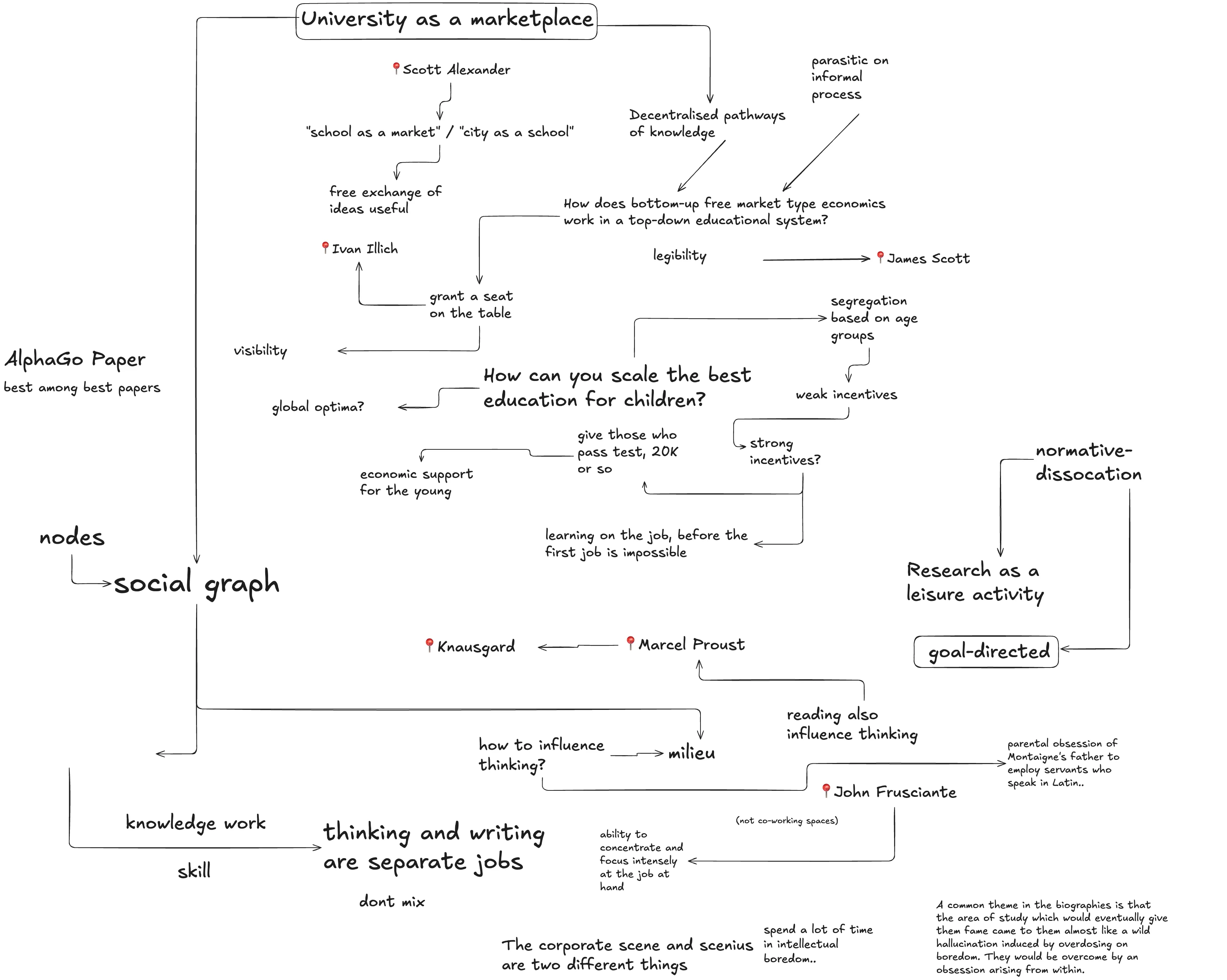
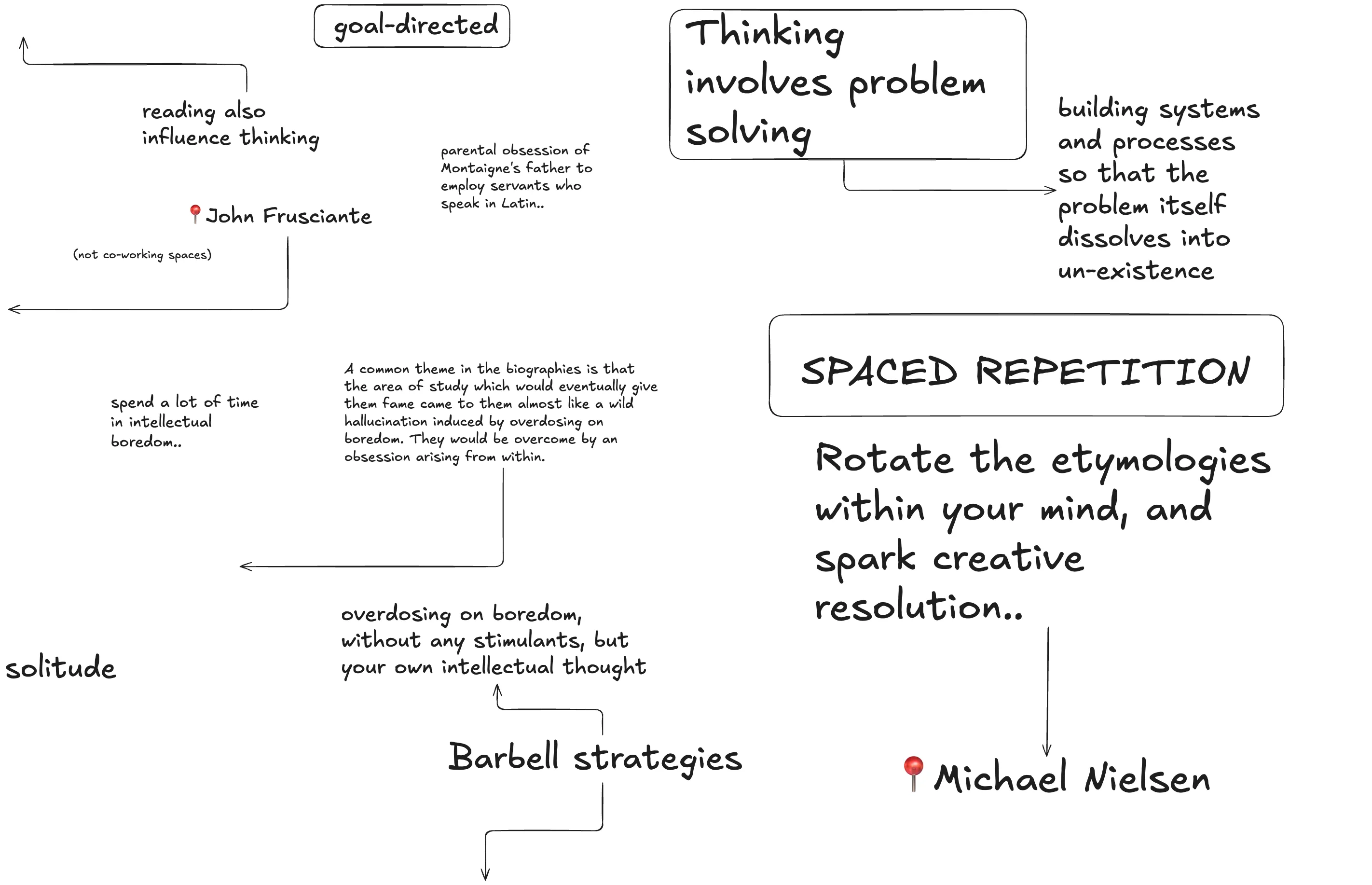
Of course, it’s hard to describe ALL the ideas that have been captured, I will only talk about those that have “impinged by neurons”, and have left a long lasting lingering effect, these are ideas that have left a residue after being seated in my mind for a while, not wanting to go..
1 Teaching in classrooms is an unnatural way to educate a child. The right way of children to learn is best described by Fiske, in what is called as “culture seeking”, where children need not be helped along with adults, they can sniff out and learn what’s useful and valuable in culture, and devour it, too.
2 The challenge with learning the ways of most bleeding-edge-of-tech is that most knowledge involves a tacit understanding, which can only be learnt while observing a master doing this craft. This reminded me of Auditya Venkatesh, a famous Indian landscape photographer, who had mentioned about serving as an apprentice to another eminent photographer, helping him out for 2 years, before establishing his own photography studio. Karlsson, also describes the method followed by Twitter’s Jack Dorsey, who claims to owe their programming skills by observing how experienced coders solve problems in open source repositories.Tacit knowledge is also anti-mimetic, it’s costly to spread the ideas, and in some cases, this knowledge could also be lost with time: for eg. the Polar inuit of northwest greenland who lost the ability to make kayaks.
3 Innovation takes time to diffuse onto the ether. QWERTY keyboards still exist as the convention, even though we have far superior options such as DVORAK etc. QWERTY was designed not to jam typewriters, and in some way, they’re purposefully made to make typing words slower.
4 Free market dynamics on education might not be that great an idea, as there are still important learnings any educated child should have. The best way to probably balance top-down, and bottom-up decentralised education is by providing adequate incentives for learners to clear the exams. Incentive design could be one way this problem could be solved.
5 Regarding the ideal form of curriculum, Karlsson aligns with what Christopher Alexander mentions in terms of “city as a school”, where he imagines the process of learning enriched by people all over the city: through contact with workshops, through teachers at home, or walking through the city, where you spot professionals willing to take students as their helpers/apprentices, learning, in that sense, is everywhere.
6 Thinking and writing are two separate processes. I used to mix them together in my writing, when I used to think a bit, write a bit, think a bit more, and so on. Now, I clearly demarcate these two territories, and provide ample time and space, for feeding and nourishing these two highly demanding tasks: writing, and thinking. For Karlsson, writing is “turning a net into a line”.
7 I didn’t realise that Christopher Alexander was a precursor to so many software principles, and best practises: Wikis, agile, object-oriented programming, etc. His key idea has been that architecture can unlock learning in a society. He proposed a new form-factor for schools, a series of architectural patterns that would weave those functions into the very fabric of society. We all know that “form follows function”, but the opposite of it, that “function is also influenced heavily by form” is undersold heavily as an idea. His two companion pieces, “The Timeless Way of Building”, and The Oregon experiment, 1912 pages with 253 architectural patterns, describes over and over again this concept.
8 One of the titles of his blog is that “A blog post is a very long and complex search query to find fascinating people and make them route interesting stuff to your inbox”, and this has stuck with me quite deeply. Not just to find individuals, but we have also found communities emerging this way, with examples that include Scott Alexander, or LessWrong which was summoned into existence by Eliezer Yudkowsky and Robin Hanson writing a series of “exceptionally powerful search queries (on overcoming bias)..”
9 The conventional mental model of learning is to be educated with a curriculum that best fits the average gaussian mean of the students learning the concepts. However, the other way to learn something is by being guided by those who have peaked in that domain — Finding the most talented person one can spot in the domain, and figuring out whom they are studying. Karlsson describes this method when it comes to scientific fields, where if you iterate enough, you will be able to find the top apex of the citation tree, who sit on the pinnacle of that domain. And he suggests to study them deeply and widely. For example, instead of a shallow read of a large number of papers from a domain, instead, if one really grokked the key papers well (for eg. the AlphaGo paper for reinforcement learning), the results are far more powerful. In this way, one imbibes the “healthiest norms” and internalize the good questions one can ask in the field. After all, good research also requires good taste in the art of asking novel, and interesting questions..
10 Karlsson describes how his one-year-old is in complete rapture when he first noticed a hen. And after a while, the hens do not surprise him anymore (as expected). Novelty is something that wears off over time, and to make hens interesting, one would start approaching this subject from various other topics: for instance — why did hens originally live in the jungle? what’s the biology of egg production? etc. in this way, the natural end game of any curiously motivated creature is to gravitate towards the ceiling of complexity. Simple things don’t surprise one anymore. Which is why, even the most prolific, seriously talented writers face a writers block faced with a blank piece of paper. As whatever they write, they’re surrounded by stellar complex pieces, and they’re faced with an insurmountable challenge of producing something which is far more “complex” and far more interesting than anything they’ve produced so far. This, as Karlsson describes, only leads to loneliness and sobbing. We’re shaken, and put down by the grandiose of our complex ideas.
11 Borrows and extends Vishakan Veerasamy’s idea of “good reply game”. This is considered as good etiquette to cultivate, for establishing oneself in the game of finding interesting individuals online.
12 Karlsson also describes his rather painful journey reading through autobiographical works of various prominent personalities such as Virginia Woolf, Thoreau, Descartes etc, and a pattern which he could find was the ability to be immersed in boredom for prolonged periods of time. Woolf in her works has lamented “I have to delve from books, painfully and alone, what you get every evening sitting over fire and smoking your pipe with Strachey etc”.. he claims that they get into a state of wild hallucination induced by overdosing on boredom.. (which I personally found very fascinating, and realised how less I indulged in this boredom-induced-psychedelic)
13 Talks about the ‘practise meant for the internet’, Karlsson has found it useful to use the internet when he’s sitting in his study, almost as if he were going to gym. He likes the ritual around “climbing the stairs, walking past the bookshelves, and sitting down at the desk”, helping shape his expectations with the hope that reading and writing with the aid of internet continues to be a salient practise.
14 His note taking system mainly consists of three pillars: list of projects, list of problems, and list of questions he is working on. This reminds me also of what Feynman used to cultivate as a practise which is to think of, the “12 key problems”. FIXME
15 Goal-driven attention provides a push to ‘chase your reading’. He cites this example of the experience while looking for a friend in the crowd, and suddenly, you start noticing the faces that otherwise would have just been a background blur. For Karlsson, if we have to get more value out of the books we read, we need to have a goal with the reading. A question which we’re curious to answer for ourselves. And if we’re always being pushed by the algorithms, then our mind will treat information in the same way it treats faces in a crowd.
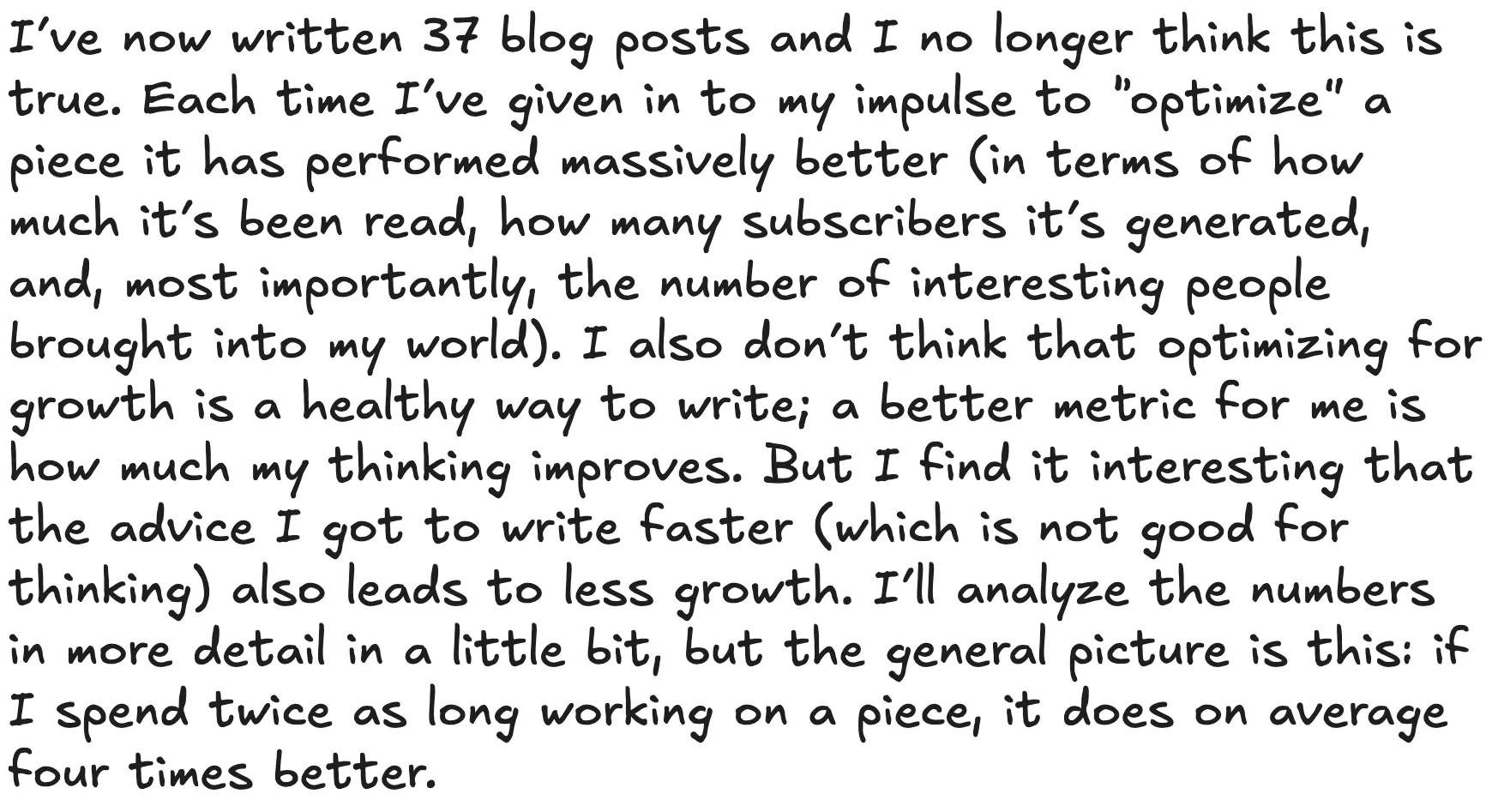
16 An unconventional writing advice from Karlsson here is to not “optimize” for shipping more drafts as fast as possible to the public. Instead, there is a much bigger ROI if one where to optimize the blog which is already performing well..”If you have the taste and skill necessary to figure out how to improve an already written piece, doing so means you are starting from a place where the rate of change is higher than if you start a new piece. So why waste that and pull a new sample?”. He suggests, instead of pushing for quantity, to rather aim for quality that matches one’s taste ceiling when it comes to writing..
17 For learning new topics fast, a technique which Karlsson describes on how Michael Nielson does it, interested me. The trick here is to internalise the core fundamental lessons through spaced-repetition techniques, making it easier and easier to work those concepts in our head. This helps subconscious draw parallels. Nielson describes this process: “When you go deep, probing the assumptions, looking from multiple angles, and reformulating things in your own words, the ideas become part of you. This is one of the reasons why I write. When I unpack things fully, the ideas become objects that I can rotate in my mind.”. He had been so immersed in mathematics, contemplating it nearly every waking hour for decades—so his mind sprouted the most surprising and revolutionary affordances. Through spaced repetition based flaschards, Nielson is able to rotate the etymologies concerning the topic in interesting ways, so that he could get to creative resolution in any easy way, sparking newer ideas..
18 We spoke about the need for “overdosing on boredom”, without any stimulants, for cultivating intellectual thought and creativity. And Karlsson also notes the opposite of this barbell, which is to forcing yourself to produce more throughput. In fact, Knausgaard, the famous Norwegian writer describes how he used to force himself to write five pages a day to overcome his own tendency to freeze up in shame. Every time Knausgaard got acclimated to the pace of writing, he increased his quota so he would always be overwhelmed. At one point, he forced himself to write 25,000 words in 24 hours, about a third of a normal-sized novel. What I could sense here is that both ends of the barbell, the intense boredom, and intense throughput, are both useful, and can be adapted to specific situations, as and when..
Read more
- Home is where the feeling of home residesreflections
- Notes on doing most good, doing some good, and living goodphilanthropy
- Notes on Londontravel
- Venn-diagram based decision makingmathematics
- Co-creative loops are everywheremental-models
- Life lessons and hot takes from my 30slifestyle
- Building a skill for coherent science illustrationsscience
- My agentic engineering workflow (step by step)agentic-coding
- Hammock driven developmentagentic-coding
- Peculiar ways number three fits into our funny little brainsmental-models
- AI sandwich as a defacto principle for anything agentic engineering relatedagentic-coding
- Authority in the guise of evidencecritical-rationalism
- Map is not the territoryphilosophy
- Self hypnosis as a manifestation ritualmeditation
- Hegelian dialectic for structured reasoning with AI agentsphilosophy
- How I prepare for tough negotiations nowadaysnegotiation
- When should we steelthread somethingproduct-development
- Breadboarding, shaping, slicing, and steelthreading solutions with AI agentsproduct
- Healthy conflict in teams have a tipping pointteam-building
- How I deslopify AI writingwriting
- How I started building softwares with AI agents being non technicalagentic-coding
- Read raw transcriptswriting
- Legible and illegible tasks in organisationsproduct
- L2 Fat marker sketchesdesign
- Writing as moats for humanswriting
- Beauty of second degree probesdecision-making
- Boundary objects as the new prototypesprototyping
- One way door decisionsproduct
- Finished softwares should existproduct
- How I periodically rank my rough draftsobsidian
- Flipping questions on its headinterviewing
- Vibe writing maximswriting
- How I blog with Obsidian, Cloudflare, AstroJS, Githubwriting
- How I build greenfield apps with AI-assisted codingagentic-coding
- We have been scammed by the Gaussian distribution clubmathematics
- Classify incentive problems into stag hunts, and prisoners dilemmasgame-theory
- I was wrong about optimal stoppingmathematics
- Thinking like a shipmental-models
- Hyperpersonalised N=1 learningeducation
- New mediums for humans to complement superintelligenceagentic-coding
- Maxims for AI assisted codingagentic-coding
- Virtual bookshelvesaesthetics
- It's computational and AI everythingagentic-coding
- Public gardens, secret routesdigital-garden
- Git way of learning to codeagentic-coding
- Style Transfer in AI writingagentic-coding
- Understanding codebases without using codeagentic-coding
- Vibe coding with Cursoragentic-coding
- Virtuoso Guide for Personal Memory Systemsmemory
- Writing in Future Pastwriting
- Publish Originally, Syndicate Elsewhereblogging
- Poetic License of Designdesign
- Idea in the shower, testing before breakfastsoftware
- Technology and regulation have a dance of ice and firetechnology
- How I ship "stuff"software
- Writing is thinkingwriting
- Song of Shapes, Words and Pathscreativity
- How do we absorb ideas better?knowledge
- Read writers who operatewriting
- Brew your ideas lazilyideas
- Trees, Branches, Twigs and Leaves — Mental Models for Writingwriting
- Compound Interest of Private Noteswriting
- Conceptual Compression for LLMsagentic-coding
- Meta-analysis for contradictory research findingsdigital-health
- Proof of workproduct
- Gauging previous work of new joinees to the teamleadership
- Task management for product managersproduct
- Beauty of Zettelswriting
- Stitching React and Rails togetheragentic-coding
- Exploring "smart connections" for note takingwriting
- Deploying Home Cooked Apps with Railssoftware
- Repetitive Copypromptingwriting
- Questions to ask every decadejournalling
- Balancing work, time and focusproductivity
- Hyperlinks are like cashew nutswriting
- Brand treatments, Design Systems, Vibesdesign
- How to spot human writing on the internetwriting
- Can a thought be an algorithm?product
- Opportunity Harvestingcareers
- Everything is a prioritisation problemproduct
- Nowlifestyle
- How I do product roastsproduct
- The Modern Startup Stacksoftware
- In-person vision transmissionproduct
- How might we help children invent for social good?social-design
- The meeting before the meetingmeetings
- Design that's so bad it's actually gooddesign
- Lessons learnt interview prepping for product rolesinterviewing
- Obsessing over personal websitessoftware
- English is the hot new programming languagesoftware
- Better way to think about conflictsrisk-management
- The role of taste in building productsdesign
- Dear enterprises, we're tired of your subscriptionssoftware
- Products need not be user centereddesign
- World's most ancient public health problemsoftware
- Pluginisation of Modern Softwaredesign
- Let's make every work 'strategic'consulting
- Making Nielsen's heuristics more digestibledesign
- Startups are a fertile ground for risk takingentrepreneurship
- Insights are not just a salad of factsdesign
- Minimum Lovable Productproduct
- Methods are lifejackets not straight jacketsmethodology
- How to arrive at on-brand colours?design
- Minto principle for writing memoswriting
- Importance of Whytask-management
- Quality Ideas Trump Executionsoftware
- Why I prefer indie softwareslifestyle
- Use code only if no code failscode
- Self Marketing
- Personal Observation Techniquesdesign
- Design is a confusing worddesign
- A Primer to Service Design Blueprintsdesign
- Rapid Journey Prototypingdesign
- Visualise detailed file structures on CLIcli
- Do's and Don'ts of User Researchdesign
- Design Manifestodesign
- Complex project management for productproducts
- How might we enable patients and caregivers to overcome preventable health conditions?digital-health
- Pedagogy of the Uncharted — What for, and Where to?education
- Future of Equity with Ludovick Petersinterviewing
- Future of Ageing with Mehdi Yacoubiinterviewing
- Future of Tacit knowledge with Celeste Volpiinterviewing
- Future of Mental Health with Kavya Raointerviewing
- Future of unschooling with Che Vanniinterviewing
- Future of Rural Innovation with Thabiso Blak Mashabainterviewing
- Future of work with Laetitia Vitaudinterviewing
- How might we prevent acquired infections in hospitals?digital-health
- The why to endure any howentrepreneurship
- Design education amidst social tribulationsdesign
- How might we assist deafblind runners to navigate?social-design